Nemotron-Personas-UK: one million synthetic personas aligned to the real UK population
 Locai Labs
Locai Labs Limited, the sovereign AI computer company based in London, has released today in collaboration with NVIDIA, Nemotron-Personas-UK, an open-source dataset of 1 million privacy-preserving synthetic personas grounded in demographic, geographic, and socio-economic distributions of the UK population. Nemotron-Personas-UK enables developers to build and test UK sovereign AI systems that more accurately represent the UK’s rich diversity of people across regions, cultures, languages and demographics and so helps reduce the risk of bias in AI models without using any personal or private data.
Every synthetic persona is aligned to real demographic and occupational distributions, but no real person is represented, so you can train on realistic personas without compromising privacy.
The data was generated with NVIDIA NeMo Data Designer and using Google DeepMind’s Gemma 4 31B model [10] on 18 NVIDIA GPUs, hosted across a hybrid set-up of cloud and local compute, using Locai Labs’ own AI computer, the Locai 1. The resulting dataset is fully open source, with a CC-BY-4.0 licence, and extends the existing Nemotron Personas collection, which now contains 12 countries including the UK, France, Germany and Belgium.
Why Personas
Synthetic data has become a crucial part of training modern LLMs, but generating data at scale is difficult, as it often suffers from a lack of diversity, which can lead to a phenomenon known as model collapse [1], [2].
Seeding data generation with realistic personas is a promising way to preserve diversity. But those personas need to be representative of the population they are intended to simulate. Otherwise, synthetic data can simply reproduce existing biases. NVIDIA’s Nemotron-Personas collection addresses this by sampling personas from census-derived distributions, and the collection is already used to seed post-training data for the Nemotron models, including tool-use and general chat data.
Demand for open, representative data of this kind is now explicit in public policy. The UK government’s AI Opportunities Action Plan (2025) [3] puts a National Data Library at the centre of its strategy, calling for high-impact datasets to be made available to AI researchers and innovators. Synthetic data is what makes that openness practical: high-quality synthetic-data tooling and practices, like the persona methodology behind this dataset, let teams share data that preserves the statistical shape of a real population without exposing any real person. For Europe, where privacy expectations and data-protection rules are strict, pairing open and synthetic is what turns sovereign-data ambitions into datasets developers can actually use.
As a London-based AI lab with a track record of developing LLMs for the UK, including Locai L1-Large [4] and Jupiter-N [5], which is built on Nemotron 3 Super, we draw on synthetic data for a significant portion of our training. The lack of realistic, representative personas for the UK has therefore been an important problem for us to solve.
In collaboration with NVIDIA, we are releasing Nemotron-Personas-UK to address this. The personas are grounded in real demographic, geographic and socio-economic distributions, using census data from England and Wales (ONS Census 2021 [6]), Scotland (NRS Census 2022 [7]) and Northern Ireland (NISRA Census 2021 [8]), alongside other open government and non-government sources.
The pipeline
The pipeline follows the compound approach NVIDIA uses for the rest of the Nemotron-Personas collection and is built with NeMo Data Designer, with targeted modifications to suit the particular requirements of building such a dataset for the United Kingdom.
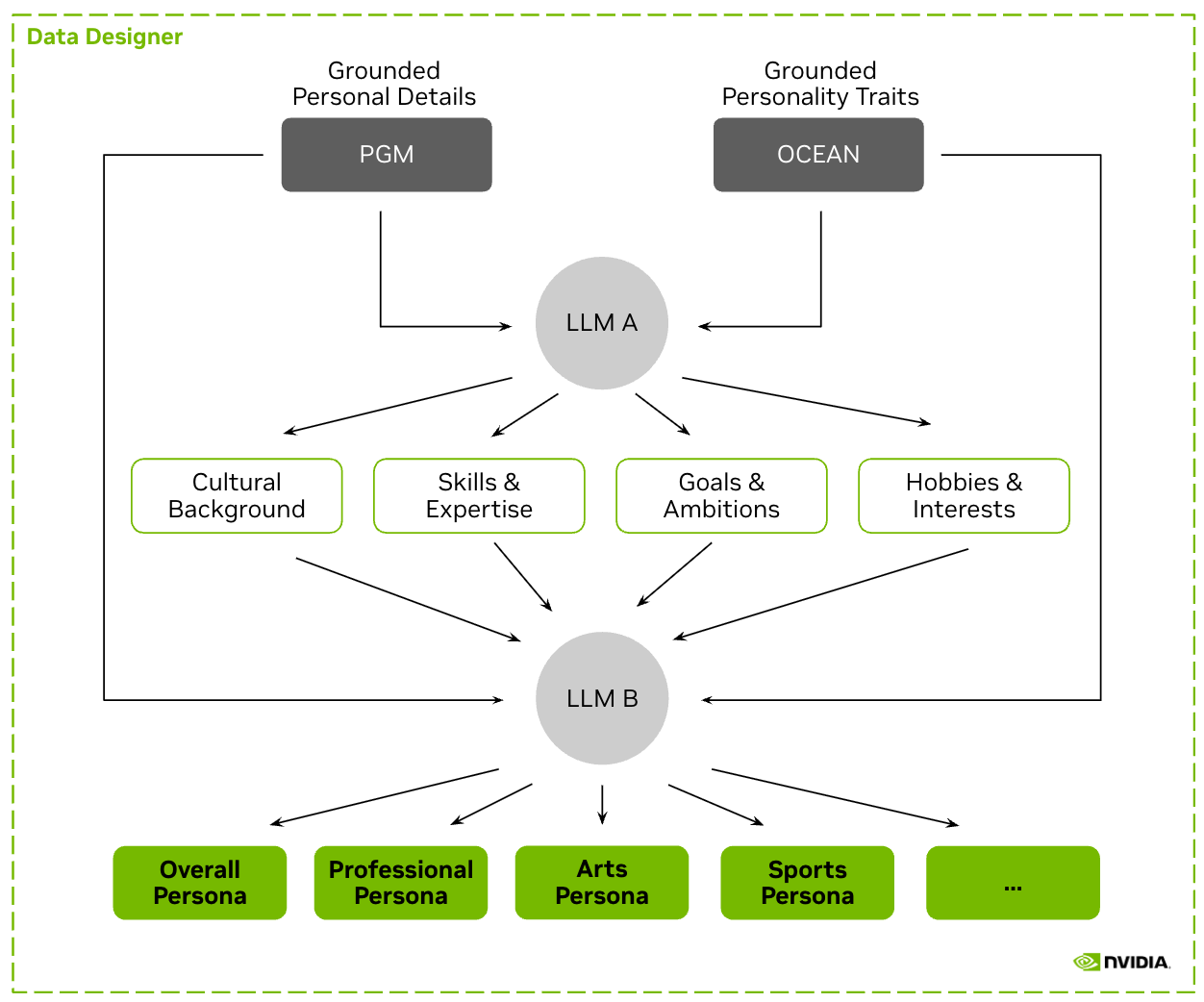
The personas are generated through a multi-stage pipeline. First, one of three Probabilistic Graphical Models (PGMs) is sampled to generate realistic combinations of demographic, geographic and socio-economic characteristics from the underlying population data, capturing relationships between attributes such as age, location, education and occupation rather than sampling each independently. Each persona is also assigned Big Five (OCEAN) personality traits [9]. Trait scores are converted to short text descriptions that the language model can use directly in its prompt such as “high conscientiousness” or “low extroversion”.
These structured inputs are then passed to Gemma 4 31B [10], which generates the core persona attributes such as cultural background, skills, career goals and hobbies. We then synthesise these attributes into richer, coherent persona descriptions and contextual variants using a subsequent model inference stage. This combination of statistical grounding, personality modelling and staged LLM generation allows us to create diverse, internally consistent personas at scale while keeping the overall population aligned with real-world distributions.
Challenges unique to the UK
The United Kingdom is home to around 67 million people across four nations, each with its own history, languages and institutions, and that structure shapes how the data has to be built. A distinguishing feature of the UK is that England & Wales, Scotland and Northern Ireland each run their own census under their own agency (ONS, NRS, NISRA). The three censuses differ in their questions, category definitions and published cross-tabulations, so they cannot simply be pooled into one table without distorting the joint distributions we want to preserve. We therefore generated three separate Probabilistic Graphical Models, one per agency, and sampled each nation’s personas from its own model in proportion to its adult population before adding layers to allow comparison between them.
Education needed similar care. Qualification frameworks differ across the four nations, for example GCSEs and A levels in England, Wales and Northern Ireland against National 5s and Highers in Scotland, so each census’s attainment categories had to be mapped onto the England and Wales qualification levels of the Regulated Qualifications Framework, with each Scottish qualification placed at its nearest equivalent level before they could be combined into a single UK-wide education variable.
Lastly, it was important to incorporate minority language proficiency into persona generation. Welsh, Scottish Gaelic, Scots, Ulster Scots and Irish are spoken across the UK and are strongly concentrated geographically, so a national average would misplace them: Welsh speakers should appear predominantly in Wales, not be spread evenly across the UK.
Dataset at a glance
The dataset contains:
- 1M personas (comprising 7M persona fields and 23M contextual fields)
- 0.94B tokens (0.39B persona tokens)
- 372 local authorities across England, Wales, Scotland and Northern Ireland
- Records are split by nation, in proportion to the adult population, with England & Wales at 889,311 (88.9%), Scotland 83,163 (8.3%) and Northern Ireland 27,526 (2.8%)
- 27,100 unique first names and 24,929 unique surnames
To check fidelity, we compared the dataset with the census at local authority level. Figure 2 shows the share of adults aged 65 and over in each area, in the dataset (left) and in the census (right). The dataset reproduces the broad spatial pattern, with older populations along the south-west and East Anglian coasts and in rural Wales and Scotland, and younger populations in London and other large cities.
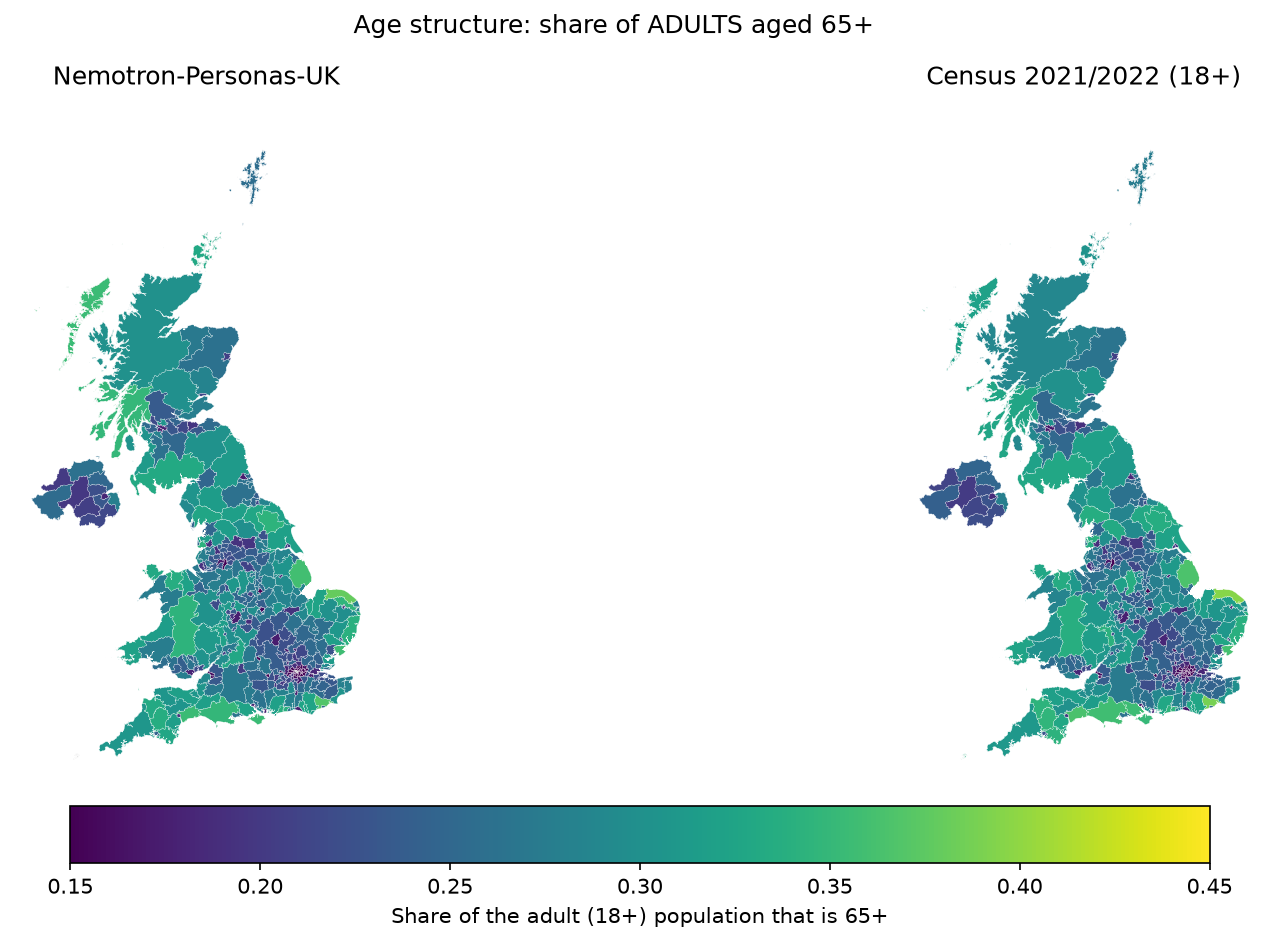
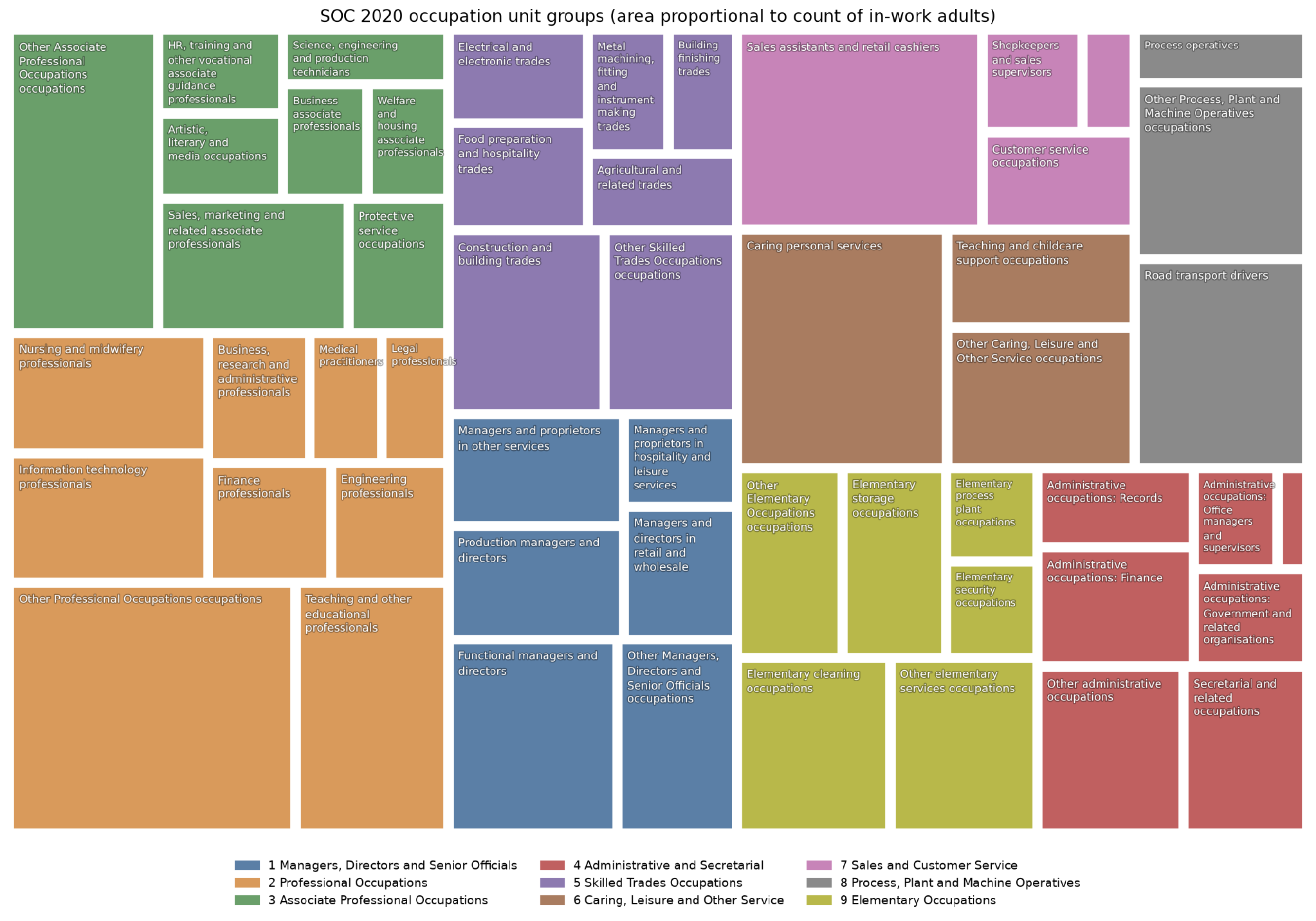
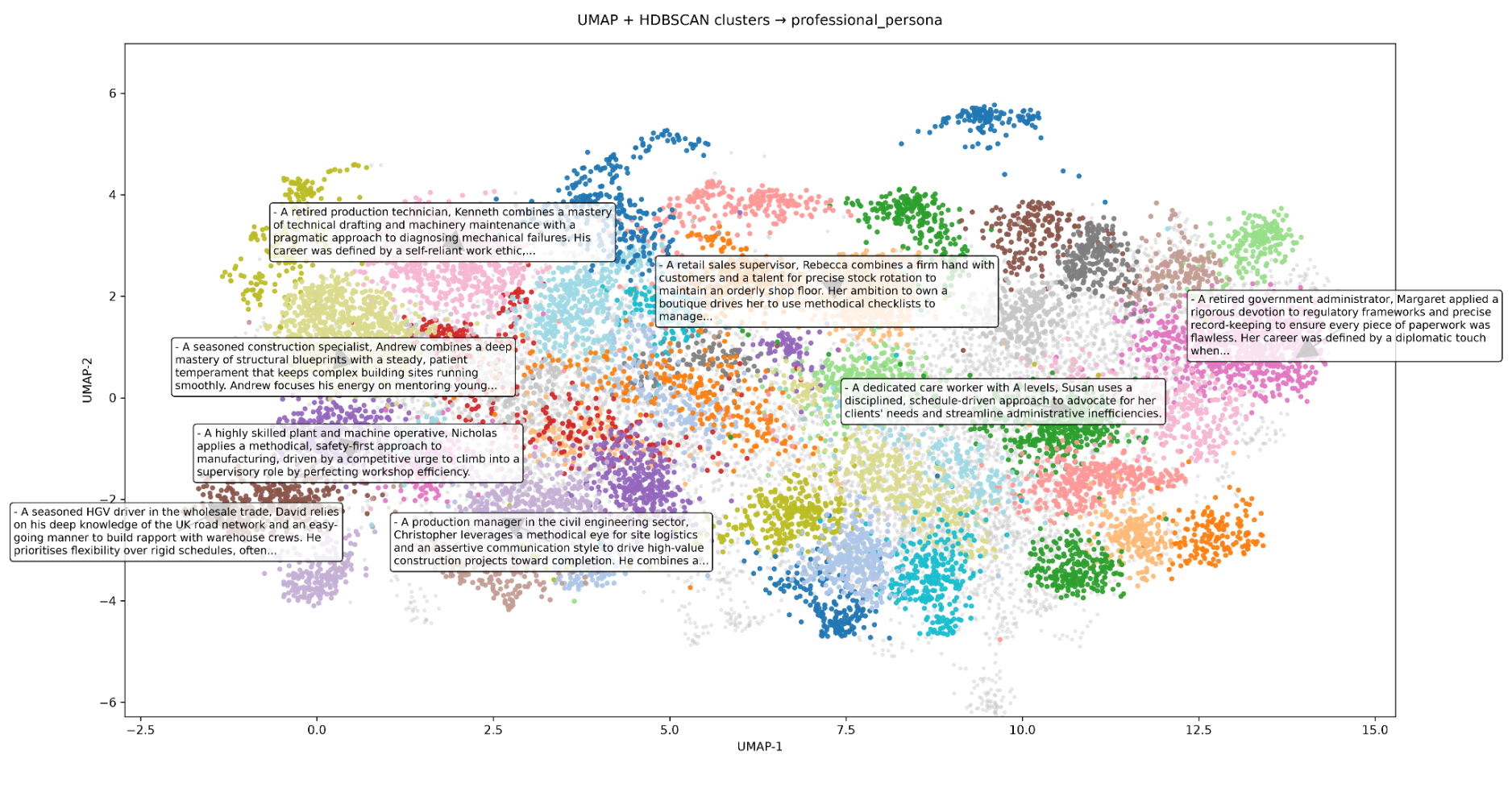
Figure 3 shows the occupational mix by SOC 2020 unit group, with area proportional to the number of in-work adults and Figure 4 highlights a multitude of clusters within professional persona descriptions. These clusters are identified by clustering embeddings and reducing dimensionality to 2D (HDBSCAN clustering, UMAP projection), demonstrating the diversity of the personas.
Every persona starts from open, aggregated statistics. Each nation’s census forms its own probabilistic model: ONS Census 2021 [6] for England and Wales, NRS Scotland’s Census 2022 [7] and NISRA Census 2021 [8] for Northern Ireland. These supply age, sex, ethnicity, religion, language, household, education, work, health and location information. The models are extended with:
- pay from the ONS and NISRA Annual Survey of Hours and Earnings [11], [12];
- travel, food and banking habits from DCMS, Welsh Government, ONS, DfT, DEFRA, NISRA and CMA statistics [13]–[19];
- regional Big Five personality means from Rentfrow, Jokela & Lamb (2015, CC BY 4.0) [9].
Names come from ONS, NRS and NISRA baby-name statistics [20]–[22] and from Companies House Persons with Significant Control (PSC) first-name and surname counts by nationality [23], with only aggregated counts used and at least 10 holders per name. CSO Ireland [24] and US SSA birth names [25] along with other Nemotron Personas datasets’ names [26] are classified by likely country of origin to name immigrant and descendant of immigrant personas. Holiday places are checked against the ONS Index of Place Names [27], and holiday destinations are weighted using the ONS Rural Urban Classification [28]. Gemma 4 [10] then writes the persona text from each sampled profile.
Practical use-cases
This dataset is made for developers working on sovereign AI. Example use-cases include:
- Generating diverse synthetic data seeded with realistic personas
- Training personalisation engines that reflect the UK’s rich demographic and cultural variety
- Evaluating models in domain-specific applications, such as healthcare and finance
- Fine-tuning models on culturally grounded data
- Evaluating model bias across rural and urban populations, age groups and education levels, to help check that systems perform more consistently across the UK
Nemotron-Personas-UK is also Locai Labs’ contribution to a global effort to ground user simulation in sovereign data. At this year’s GTC Berlin, NVIDIA launched NeMo User Sim, an open-source library for population-scale simulation that lets developers evaluate and train AI agents across dynamic conversations in local languages, without using personal data. NeMo User Sim leverages Nemotron-Personas, the partner-grounded datasets that make that simulation representative of each country’s population.
Nemotron-Personas-UK is available on Hugging Face at huggingface.co/datasets/nvidia/Nemotron-Personas-UK.
 View on Hugging Face
If you found the dataset useful, please cite:
@software{nvidia/Nemotron-Personas-UK,
author = {Stephens, Sam, and Jennings, Will, and Meyer, Yev, and Drayson, George},
title = {{Nemotron-Personas-UK: Synthetic Personas Aligned to Real-World Distributions for the UK}},
month = {October},
year = {2026},
url = {https://huggingface.co/datasets/nvidia/Nemotron-Personas-UK}
}
References
- Shumailov, I., Shumaylov, Z., Zhao, Y., Papernot, N., Anderson, R. and Gal, Y., 2024. AI models collapse when trained on recursively generated data. Nature, 631(8022), pp.755–759. https://doi.org/10.1038/s41586-024-07566-y
- Drayson, G., Yilmaz, E. and Lampos, V., 2025, November. Machine-generated text detection prevents language model collapse. In Proceedings of the 2025 Conference on Empirical Methods in Natural Language Processing (pp. 29645–29661).
- Department for Science, Innovation and Technology, 2025. AI Opportunities Action Plan. UK Government. Available at: https://www.gov.uk/government/publications/ai-opportunities-action-plan.
- Drayson, G. 2025. Locai L1-Large: An open-source instruct model. https://locailabs.com/blog/technical-blog.
- Drayson, G., 2026. Jupiter-N Technical Report. arXiv preprint arXiv:2604.17429. https://arxiv.org/abs/2604.17429.
- Office for National Statistics (ONS), 2023. Census 2021 (England and Wales). Custom datasets via the ONS “Create a custom dataset” service. Available at: https://www.ons.gov.uk/census. Open Government Licence v3.0.
- National Records of Scotland (NRS), 2024. Scotland’s Census 2022. Flexible Table Builder and published tables. Available at: https://www.scotlandscensus.gov.uk. Open Government Licence v3.0.
- Northern Ireland Statistics and Research Agency (NISRA), 2023. Census 2021 (Northern Ireland). Flexible Table Builder and published tables. Available at: https://www.nisra.gov.uk/statistics/census. Open Government Licence v3.0.
- Rentfrow, P.J., Jokela, M. and Lamb, M.E., 2015. Regional personality differences in Great Britain. PLoS ONE, 10(3), e0122245. https://doi.org/10.1371/journal.pone.0122245. CC BY 4.0.
- Gemma Team, Google DeepMind, 2026. Gemma 4 Technical Report. arXiv preprint arXiv:2607.02770. https://arxiv.org/abs/2607.02770.
- Office for National Statistics (ONS), 2024. Annual Survey of Hours and Earnings (ASHE), 2024. Available at: https://www.ons.gov.uk/employmentandlabourmarket/peopleinwork/earningsandworkinghours. Open Government Licence v3.0.
- Northern Ireland Statistics and Research Agency (NISRA), 2024. Annual Survey of Hours and Earnings (Northern Ireland), 2024. Available at: https://www.nisra.gov.uk/statistics/work-pay-and-benefits/annual-survey-hours-and-earnings. Open Government Licence v3.0.
- Department for Culture, Media and Sport (DCMS), 2025. Participation / Community and Engagement Survey 2025–26 (domestic tourism). Available at: https://www.gov.uk/government/statistics/community-and-engagement-survey-2025-26. Open Government Licence v3.0.
- Welsh Government, 2025. Domestic GB tourism statistics: overnight trips in Wales, 2024. Available at: https://www.gov.wales/domestic-gb-tourism-statistics-overnight-trips-wales-2024-html. Open Government Licence v3.0.
- Office for National Statistics (ONS), 2025. Travel Trends 2024. Available at: https://www.ons.gov.uk/peoplepopulationandcommunity/leisureandtourism/datasets/ukresidentsvisitsabroad. Open Government Licence v3.0.
- Department for Transport (DfT), 2024. National Travel Survey (tables NTS0403, NTS0407) and National Travel Attitudes Study, wave 10. Available at: https://www.gov.uk/government/statistical-data-sets/nts04-purpose-of-trips and https://www.gov.uk/government/statistics/national-travel-attitudes-study-wave-10. Open Government Licence v3.0.
- Department for Environment, Food and Rural Affairs (DEFRA), 2022–2025. Family Food datasets (financial years ending 2022, 2024 and 2025). Available at: https://www.gov.uk/government/statistical-data-sets/family-food-datasets. Open Government Licence v3.0.
- Northern Ireland Statistics and Research Agency (NISRA), 2025. Northern Ireland tourism statistics 2024. Available at: https://www.nisra.gov.uk/statistics/tourism. Open Government Licence v3.0.
- Competition and Markets Authority (CMA), 2016. Retail banking market investigation: final report. Available at: https://assets.publishing.service.gov.uk/media/57ac9667e5274a0f6c00007a/retail-banking-market-investigation-full-final-report.pdf. Open Government Licence v3.0.
- Office for National Statistics (ONS), various years. Baby names in England and Wales. Birth registration data. Available at: https://www.ons.gov.uk/peoplepopulationandcommunity/birthsdeathsandmarriages/livebirths. Open Government Licence v3.0.
- National Records of Scotland (NRS), various years. Babies’ first names and most common surnames. Available at: https://www.nrscotland.gov.uk. Open Government Licence v3.0.
- Northern Ireland Statistics and Research Agency (NISRA), various years. Baby Names in Northern Ireland. Available at: https://www.nisra.gov.uk/baby-names/latest-release. Open Government Licence v3.0.
- Companies House, 2026. People with significant control (PSC) snapshot, 29 September 2026. Available at: https://download.companieshouse.gov.uk/en_pscdata.html. Contains information from Companies House.
- Central Statistics Office (CSO), various years. Irish Babies’ Names. Available at: https://www.cso.ie/en/releasesandpublications/ep/p-ibn/irishbabiesnames2024/.
- U.S. Social Security Administration (SSA), various years. Baby Names from Social Security Card Applications: National Data. Available at: https://www.ssa.gov/oact/babynames/limits.html.
- NVIDIA, 2025–2026. Nemotron-Personas collection. Hugging Face. Available at: https://huggingface.co/collections/nvidia/nemotron-personas. CC BY 4.0.
- Office for National Statistics (ONS), 2024. Index of Place Names in Great Britain (July 2024). ONS Open Geography Portal. Available at: https://geoportal.statistics.gov.uk. Source: Office for National Statistics licensed under the Open Government Licence v3.0. Contains OS data © Crown copyright and database right 2024. Contains Royal Mail data © Royal Mail copyright and database right 2024.
- Office for National Statistics (ONS), 2021. Rural Urban Classification (2021). ONS Open Geography Portal. Available at: https://geoportal.statistics.gov.uk. Source: Office for National Statistics licensed under the Open Government Licence v3.0.
Enjoyed this article?
Share it with your network