Definition
What is a domain-specific LLM?
A domain-specific language model (DSLM) is trained to be an expert in your field, not a generalist that knows a little about everything.

In short
A domain-specific LLM (DSLM) is a large language model post-trained on a particular organisation's or industry's data, documents, and workflows so it reasons like an expert in that domain, often outperforming much larger general-purpose models on the tasks that domain cares about.
Why specialised beats general
General models are trained to know a little about everything from the public internet. A domain-specific model is trained deeply on your world, your terminology, your precedents, your processes, so it gives answers that are correct in your context, not just plausible in general.
Crucially, specialisation lets a smaller, cheaper-to-run model beat a much larger generalist on your tasks, which makes owning and deploying it inside your perimeter practical.
How Locai builds a DSLM without breaking it
Naive fine-tuning causes catastrophic forgetting: the model gains your domain but loses general reasoning. Locai's Forget-Me-Not framework adds deep domain expertise while preserving the base model's general capability, so you get an expert that still reasons well.
With Locai
What thislooks like with Locai.
Sovereignty stops being a contractual promise when the machine is standing in your own building. Here is what that looks like in practice.
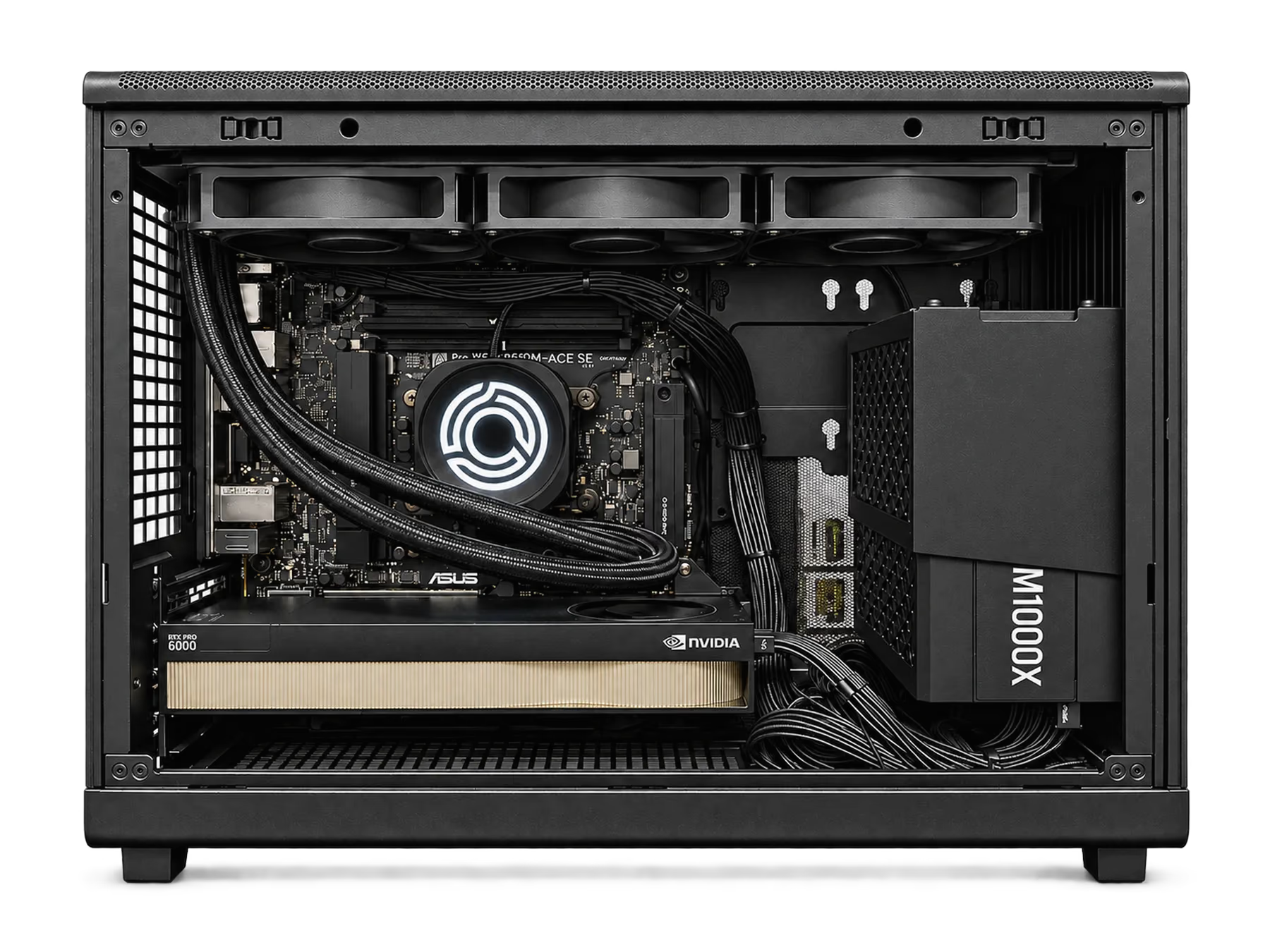
Locai Labs builds Locai 1, an on-prem AI appliance. It is one machine that arrives with everything already in it: the hardware, our open-weight Locai Juno models, and Locai OS, the operating system that serves the models and handles users, access and monitoring. You plug it into a mains socket and your network, and your team is working in about 15 minutes. No cloud account, no per-token bill, and nothing leaving the building.
The reason a data-centre-class model fits in an AI computer on your floor is SPACE, our compression algorithm. Instead of asking how much of a model can be cut while keeping it broadly similar, SPACE asks what the model needs to be good at, preserves the subnetworks behind those capabilities and strips back the rest. The result is a smaller specialist rather than a shrunken generalist, tuned to the exact hardware it ships on.
Locai 1 Nano starts at £9,910, Locai 1 at £24,999, and Locai 1 Pro at £54,950 with two GPUs, bought once and owned outright. Locai 1 Nano and Locai 1 run from a standard wall socket, and every configuration can run fully air-gapped. Any compatible open-weight model runs alongside Juno, and if you need a model trained on your own proprietary data we can post-train one and deploy it on the same machine.
From Locai Labs
Locai 1.Owned outright.
The AI computer for the whole team. Hardware, Locai OS, Juno models and the Locai Agent in one. From £9,910, owned outright, with no per-token bills.
FAQ
Questions,answered.
How is a DSLM different from RAG?
Retrieval (RAG) bolts a search index onto a general model at query time; a DSLM bakes the domain into the model's weights through post-training. The two are complementary, but only post-training changes how the model actually reasons.
What data do I need to build one?
Most structured and unstructured formats work, documents, PDFs, databases, logs, proprietary formats. You don't need clean, labelled data; data preparation is part of the process.
Do I own the resulting model?
Yes. With Locai the domain-specific model, its weights, and the post-training pipeline are yours.
Planning a deployment?Book a sovereign AI briefing.
A 30-minute session on owning your model: deployment options, the data path, and a clear cost range for your use case.